Starting a vertical farm in the United States can require anywhere from tens of thousands of dollars for a small pilot setup to millions of dollars for a large commercial facility. The actual vertical farming startup cost depends on farm size, facility type, growing technology, lighting, HVAC and dehumidification, automation, labor, local utility costs, and working capital.
For a small farm using an existing room or warehouse, the initial investment can be significantly lower than building a fully equipped commercial facility from the ground up. This is why published estimates for vertical farming costs can look very different: some estimates cover only growing equipment, while others include facility construction, electrical upgrades, climate control, installation, and pre-opening expenses.
This guide focuses primarily on the U.S. market in 2026 and explains the major costs involved in starting and operating a vertical farm. You will learn how much different types of farms can cost, where the money goes, how operating expenses affect profitability, and how to evaluate potential ROI before investing.
Quick answer: There is no single fixed price for starting a vertical farm. A realistic budget should separate startup costs (CAPEX) from ongoing operating costs (OPEX) and should also include enough working capital to operate the farm during its ramp-up period.
How Much Does It Cost to Start a Vertical Farm in the U.S.?
The cost of starting a vertical farm in the U.S. varies widely depending on the scale, facility, crop, and technology used.
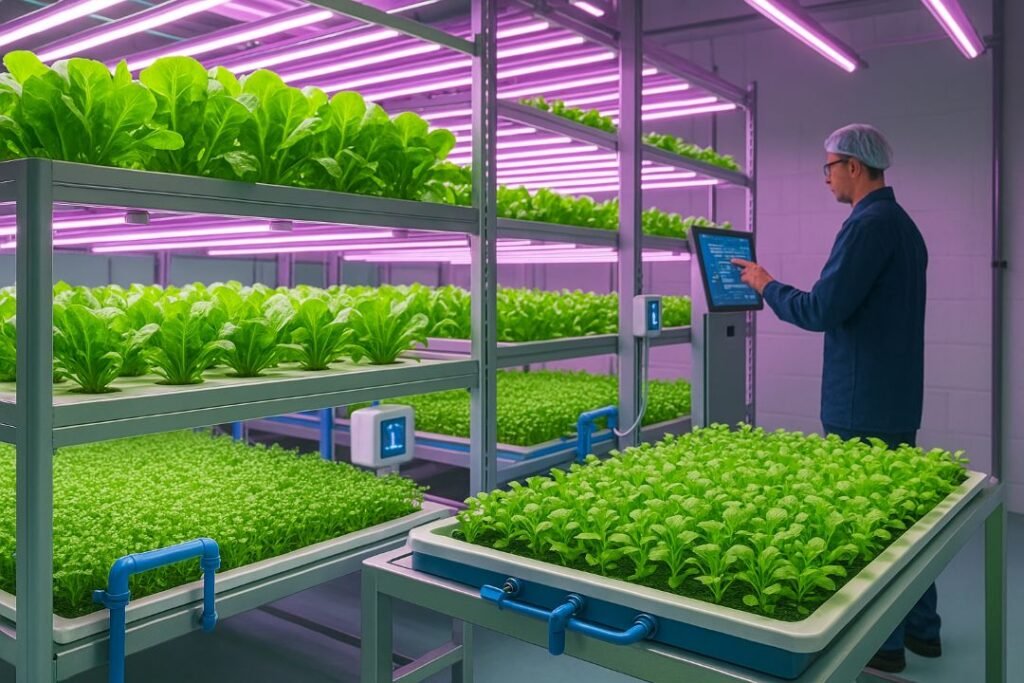
A small pilot farm operating inside an existing space may require a relatively modest investment in racks, LED lighting, growing equipment, environmental controls, and initial supplies. A commercial warehouse conversion can require substantially more capital because of electrical service, HVAC, dehumidification, plumbing, building improvements, automation, food-safety infrastructure, and installation.
For this reason, it is more useful to think about vertical farming startup cost as a range rather than a single number.
Estimated Vertical Farm Startup Cost by Scale
| Farm type | Typical size | Planning-level startup budget |
|---|---|---|
| Small pilot | 500–1,000 sq. ft. | $50,000–$150,000+ |
| Small commercial | 1,000–5,000 sq. ft. | $100,000–$500,000+ |
| Mid-scale commercial | 5,000–20,000 sq. ft. | $500,000–$2 million+ |
| Large commercial | 20,000+ sq. ft. | $2 million+ |
Important: These are planning ranges rather than guaranteed project costs. A facility that already has adequate electrical capacity, plumbing, insulation, cooling, and other infrastructure can cost much less to fit out than a building that needs major upgrades. A highly automated commercial farm can also cost substantially more.
The U.S. Department of Agriculture has previously highlighted the high capital intensity of vertical farming, while more recent 2026 industry estimates show that full indoor-farm build-outs can reach several hundred dollars per square foot depending on the scope of construction and equipment.
Why Do Vertical Farming Cost Estimates Vary So Much?
If you compare different vertical farming cost estimates, you may find very different numbers. That does not necessarily mean one estimate is wrong.
The key question is:
What exactly is included in the estimate?
A growing-system estimate may include:
- Vertical racks
- LED fixtures
- Hydroponic equipment
- Pumps and reservoirs
- Sensors
- Basic controls
A complete commercial project may also include:
- Warehouse renovation
- Electrical service upgrades
- HVAC
- Dehumidification
- Plumbing
- Insulation
- Flooring
- Food-safety infrastructure
- Automation
- Engineering and design
- Installation
- Permits
- Insurance
- Initial inventory
- Working capital
Therefore, always check the assumptions before comparing two published vertical farming cost estimates.
Vertical Farm Cost Per Square Foot
Cost per square foot is a useful metric for comparing vertical farming projects, but it must be interpreted carefully.
Current 2026 industry construction estimates for warehouse-based indoor vertical farms can reach approximately $200–$500 per square foot of building footprint for highly equipped facilities. Other sources report much lower figures because they are measuring equipment packages, modular systems, or partial build-outs rather than the complete facility.
This distinction is critical.
Growing Infrastructure
This includes the equipment directly used to grow crops:
- Growing racks
- LED lighting
- Hydroponic or aeroponic systems
- Pumps
- Reservoirs
- Trays
- Sensors
- Irrigation equipment
Facility Infrastructure
This includes the infrastructure needed to create a suitable controlled environment:
- HVAC
- Dehumidification
- Electrical systems
- Plumbing
- Insulation
- Flooring
- Water treatment
- Fire and life-safety systems
Business and Pre-Opening Costs
These expenses are often overlooked in simple startup estimates:
- Engineering and design
- Permits
- Insurance
- Installation
- Staff training
- Initial supplies
- Marketing
- Product development
- Commissioning
- Working capital
This three-layer approach gives a much more realistic picture of the true vertical farming startup cost.
What Is the Cheapest Way to Start a Vertical Farm?
If your goal is to minimize initial investment, the cheapest approach is usually not to construct a new building.
Instead, consider using an existing warehouse, commercial space, or suitable indoor facility with adequate ceiling height, electrical capacity, drainage, and climate-control potential.
A warehouse retrofit can reduce the amount of new construction required, but it is not automatically cheap. Electrical service, HVAC, dehumidification, food-safe finishes, plumbing, and structural requirements can still become major expenses.
Before signing a lease, evaluate:
- Electrical service capacity
- Ceiling height
- Floor loading
- Water supply
- Drainage
- HVAC potential
- Insulation
- Fire-safety requirements
- Lease length
- Landlord approval for improvements
- Local zoning and permitting
A low-rent warehouse with inadequate power can ultimately be more expensive than a higher-rent facility that already has the infrastructure your farm needs.
Vertical Farming Startup Cost Breakdown
The following categories represent the major expenses you should evaluate when preparing a U.S. vertical farm budget.
1. Facility and Warehouse Cost
The facility is one of the first decisions that affects the entire project budget.
Instead of focusing only on monthly rent, evaluate the total cost of occupying and preparing the facility.
Potential expenses include:
- Lease or purchase costs
- Security deposit
- Building improvements
- Insulation
- Flooring
- Drainage
- Electrical upgrades
- Plumbing
- Fire-safety improvements
- HVAC installation
- Loading and storage areas
For a leased facility, the length of the lease also matters. Spending hundreds of thousands of dollars on permanent improvements in a short-term lease can create significant financial risk.
Tip: If you are considering a warehouse retrofit, negotiate improvement allowances and landlord responsibilities before signing the lease.
2. LED Lighting System
LED lighting is essential for fully indoor vertical farming because crops cannot rely on sunlight.
Your lighting budget depends on:
- Crop type
- Light intensity
- Photoperiod
- Rack density
- Number of growing tiers
- Fixture efficiency
- Installation requirements
- Controls and dimming capability
Rather than choosing the cheapest fixtures, compare them using:
PPFD + efficacy + useful lifetime + warranty + electricity consumption
The initial price of an LED fixture is only part of the calculation. A more efficient fixture can reduce electricity costs over thousands of operating hours.
3. HVAC and Dehumidification
HVAC is one of the most important—and often underestimated—components of a vertical farm.
A commercial indoor farm must control:
- Temperature
- Relative humidity
- Air movement
- Vapor pressure deficit
- Heat generated by lighting
- Moisture released by plants
Plants continuously release water into the growing environment through transpiration. In a sealed indoor facility, that moisture must be managed through ventilation, dehumidification, or other climate-control systems.
Recent 2026 construction estimates indicate that HVAC and dehumidification can represent a very large share of a vertical-farm build budget, particularly in highly controlled facilities.
Why HVAC Matters to ROI
An undersized system can lead to:
- High humidity
- Disease pressure
- Poor crop quality
- Mold
- Condensation
- Lower yields
An oversized or poorly designed system can unnecessarily increase capital and energy costs.
For this reason, HVAC should be designed around the crop, lighting load, facility envelope, and production density, rather than selected as an afterthought.
4. Hydroponic or Aeroponic Growing System
The growing system provides the physical and nutrient-delivery infrastructure for crop production.
Depending on your crop and production model, this may include:
- Nutrient reservoirs
- Pumps
- Pipes
- Channels
- Grow trays
- Irrigation systems
- Filters
- Sensors
- Water-treatment equipment
- Nutrient dosing systems
For many leafy-green operations, hydroponic systems can provide a relatively straightforward starting point.
Aeroponic systems can offer advantages in water and root-zone management, but they may require more sophisticated equipment and maintenance.
The cheapest system is not necessarily the most profitable system.
Choose the system based on:
Crop + labor + reliability + maintenance + yield + market price
5. Growing Racks and Shelving
Vertical racks are what allow indoor farms to multiply growing area without increasing the building footprint.
Your rack investment depends on:
- Number of tiers
- Rack dimensions
- Material
- Load requirements
- Lighting integration
- Irrigation integration
- Automation
- Accessibility for workers
A higher number of tiers can increase production capacity, but it also increases complexity.
More tiers may require:
- More lighting
- More airflow
- More irrigation
- More structural capacity
- More labor access
- More climate-control capacity
Therefore, maximizing rack height is not automatically the best financial decision.
6. Electrical Infrastructure
Electrical infrastructure is one of the costs that can surprise first-time vertical farm operators.
A warehouse designed for normal industrial use may not have sufficient electrical capacity for:
- Hundreds of LED fixtures
- HVAC equipment
- Dehumidifiers
- Pumps
- Fans
- Refrigeration
- Automation
- Processing equipment
Potential expenses include:
- Main service upgrade
- Transformers
- Panels
- Subpanels
- Distribution
- Conduit
- Wiring
- Emergency systems
Before leasing a building, have a qualified electrical professional evaluate whether the existing service can support your planned load.
This assessment should happen before signing the lease—not after.
7. Automation, Sensors, and Farm Software
Automation can help reduce repetitive labor and improve environmental consistency.
A modern vertical farm may use:
- Temperature sensors
- Humidity sensors
- CO₂ sensors
- Light sensors
- Water-level sensors
- EC and pH monitoring
- Automated nutrient dosing
- Climate-control software
- Farm management platforms
- Remote monitoring
However, automation should be evaluated based on ROI.
Do not automate a process simply because the technology is available.
Ask:
How much labor will this system save, how much yield or consistency will it improve, and how long will it take to pay for itself?
8. Labor and Training
Labor remains a significant operating expense even in highly automated farms.
Workers may be required for:
- Seeding
- Transplanting
- Crop monitoring
- Harvesting
- Washing
- Packaging
- Sanitation
- Equipment maintenance
- Order fulfillment
The actual labor requirement depends heavily on automation and crop type.
Leafy greens, herbs, and microgreens can have very different labor profiles.
When preparing your business plan, calculate labor based on hours required per production cycle, rather than simply estimating one employee’s salary.
9. Licensing, Permits, and Insurance
Regulatory requirements vary by state, county, and municipality.
Depending on the operation, you may need to investigate:
- Business licensing
- Zoning approval
- Building permits
- Electrical permits
- Plumbing permits
- Fire-safety requirements
- Food-safety requirements
- Produce handling requirements
- Wastewater requirements
- Insurance
Do not assume that an agricultural business automatically qualifies for agricultural exemptions inside an urban or industrial building.
Check local requirements before investing in the facility.
10. Working Capital
This is one of the most important additions to a vertical farming startup budget.
Your startup capital should not be spent entirely on equipment.
You may need cash reserves for:
- Rent
- Electricity
- Labor
- Seeds
- Nutrients
- Packaging
- Maintenance
- Insurance
- Distribution
- Marketing
- Unexpected repairs
The farm may need several production cycles before it reaches stable output and reliable sales.
A business plan should therefore include a working-capital reserve, rather than assuming the farm becomes profitable immediately after installation.
Estimated Startup Budget for a 1,000 Sq. Ft. Vertical Farm
A 1,000 sq. ft. farm can be useful as a pilot or small commercial operation, but its total budget will depend heavily on the condition of the existing facility.
A planning budget can be organized like this:
| Cost category | Planning range |
|---|---|
| Facility preparation | $10,000–$50,000+ |
| Growing racks | $10,000–$40,000+ |
| LED lighting | $10,000–$30,000+ |
| HVAC & dehumidification | $20,000–$60,000+ |
| Growing system | $15,000–$50,000+ |
| Electrical & plumbing | $10,000–$50,000+ |
| Sensors & automation | $5,000–$20,000+ |
| Permits, design & insurance | $5,000–$20,000+ |
| Initial supplies & commissioning | $5,000–$15,000+ |
| Working capital | $20,000–$60,000+ |
Important: These categories should not simply be added together to produce a guaranteed project price. Some costs overlap depending on the facility and equipment package. Obtain site-specific contractor and equipment quotes before using the budget for financing or investment decisions.
Monthly Operating Costs of a Vertical Farm
Startup cost is only half of the financial equation.
A vertical farm can have a large upfront investment but still fail if its monthly operating costs are too high.
Typical operating expenses include:
| Expense | Main cost drivers |
|---|---|
| Electricity | LEDs, HVAC, dehumidification, pumps |
| Labor | Seeding, harvesting, packing, sanitation |
| Rent | Facility location and size |
| Seeds | Crop and production volume |
| Nutrients | Growing system and crop |
| Water | Production volume and treatment |
| Packaging | Sales channel and product format |
| Maintenance | Equipment and infrastructure |
| Insurance | Facility and business risk |
| Distribution | Distance and sales model |
Electricity Cost
Energy deserves special attention because indoor farms depend heavily on artificial lighting and environmental control.
Your electricity cost can be estimated using:
Electricity cost = Power consumption × operating hours × electricity rate
For example, if a system consumes 100 kW continuously:
100 kW × 24 hours × 30 days = 72,000 kWh/month
At an electricity rate of $0.12/kWh:
72,000 × $0.12 = $8,640/month
This is only an illustration. Your actual electricity consumption will depend on lighting schedules, HVAC efficiency, climate, equipment load, crop type, and facility design.
Energy is one of the most important factors affecting vertical-farm economics, and recent research continues to identify lighting and environmental control as major drivers of energy demand.
Vertical Farm Revenue Potential
Revenue should never be estimated simply from floor area.
A better calculation is:
Revenue = Sellable production × selling price
Production depends on:
- Number of growing tiers
- Crop cycle length
- Yield per tray
- Crop losses
- Facility utilization
- Harvest frequency
Selling price depends on:
- Wholesale vs. retail
- Restaurants
- Grocery stores
- Direct-to-consumer sales
- Local market conditions
- Product quality
- Packaging
- Distribution
Example: Lettuce
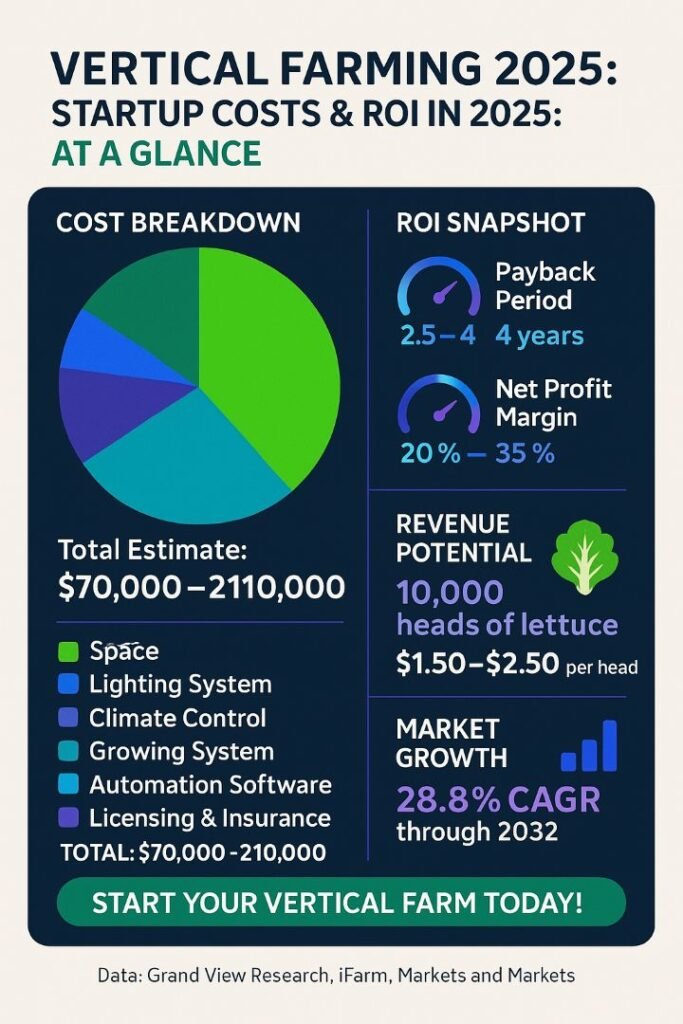
Suppose a farm produces 8,000 sellable heads of lettuce per month and achieves an average realized selling price of $1.75 per head.
8,000 × $1.75 = $14,000 monthly revenue
If the farm sells at $2.25 per head:
8,000 × $2.25 = $18,000 monthly revenue
This illustrates why production volume alone does not determine profitability.
The realized selling price and operating cost matter just as much.
ROI and Break-Even Analysis
A vertical farm should not be evaluated using revenue alone.
The basic calculation is:
Operating profit = Revenue − Operating expenses
Then:
Simple payback period = Initial investment ÷ Annual operating profit
For example, if a farm requires $250,000 in startup capital and eventually generates $75,000 in annual operating profit:
$250,000 ÷ $75,000 = 3.3 years
This is a simple payback calculation, not a guaranteed ROI.
It does not account for:
- Financing costs
- Taxes
- Depreciation
- Equipment replacement
- Major repairs
- Changes in selling price
- Crop losses
- Facility expansion
- Inflation
For a real investment decision, build a multi-year financial model.
Conservative, Base-Case and Optimistic Scenarios
Instead of assuming that a vertical farm will immediately achieve a high profit margin, create at least three scenarios.
Conservative Scenario
Assume:
- Lower selling prices
- Higher energy costs
- Higher labor requirements
- Lower crop utilization
- Some production losses
Base-Case Scenario
Use realistic assumptions based on:
- Expected yield
- Local selling prices
- Actual electricity rates
- Planned staffing
- Expected facility utilization
Optimistic Scenario
Assume:
- Strong market demand
- Higher-value crops
- Efficient energy use
- High facility utilization
- Strong labor productivity
- Reliable sales channels
The base case should be the scenario used for your primary investment decision.
The optimistic case should never be the reason you decide the project is financially viable.
What Can You Build With a $100,000 Budget?
A $100,000 budget can potentially support a small pilot or limited commercial vertical-farming operation, particularly when an existing suitable facility is available.
However, spending the entire $100,000 on equipment is usually a mistake.
A better approach is to divide the budget among:
- Growing infrastructure
- Lighting
- Climate control
- Electrical work
- Installation
- Initial inputs
- Working capital
The exact allocation depends on the facility and crop.
What About a $250,000 Budget?
A $250,000 budget can provide more room for:
- Larger growing capacity
- Better climate control
- Higher-quality equipment
- More automation
- Better post-harvest handling
- Larger working-capital reserves
But even $250,000 may be insufficient for a fully built commercial warehouse if major electrical, HVAC, and structural upgrades are required.
What About $500,000 or More?
At this level, the project can move toward a more substantial commercial operation, but the feasibility depends heavily on facility infrastructure and market demand.
The larger the project becomes, the more important it is to secure buyers and validate unit economics before committing capital.
Is Vertical Farming Profitable in the U.S. in 2026?
Vertical farming can be profitable, but profitability is not guaranteed.
The economics depend on a combination of:
- Crop selection
- Selling price
- Electricity cost
- Labor productivity
- Facility utilization
- Yield
- Automation
- Rent
- Distribution
- Financing costs
Recent research continues to identify energy demand as one of the major economic challenges of indoor vertical farming. This is why crops with higher market value—such as leafy greens, herbs, microgreens, and some specialty crops—are often more suitable for controlled-environment production than low-value commodity crops.
The Biggest Mistake New Investors Make
The biggest mistake is calculating:
Expected revenue − startup cost
instead of:
Revenue − operating expenses − financing costs − maintenance − working capital requirements
A farm can generate substantial revenue and still lose money.
How to Reduce Vertical Farming Startup Cost
You do not necessarily need to build the most technologically advanced farm from day one.
Consider these strategies:
1. Start with a Pilot
Test your crop, production process, and sales channel before investing in a large facility.
2. Use an Existing Facility
A suitable warehouse or indoor space can reduce construction requirements.
3. Evaluate Used Equipment
Some racks and equipment may be available second-hand, but inspect them carefully and calculate the cost of refurbishment.
4. Choose Crops Based on Economics
Do not select crops simply because they grow well vertically.
Evaluate:
Yield × selling price − production cost
5. Optimize Energy Efficiency
Efficient LED fixtures, HVAC systems, insulation, airflow, and climate controls can reduce recurring energy costs.
6. Secure Buyers Before Scaling
Restaurants, grocery stores, distributors, and direct customers should be part of the business plan before expanding production capacity.
7. Automate Where It Pays
Automation should reduce labor or improve consistency enough to justify its cost.
Key Factors That Determine Vertical Farming ROI
Before investing, evaluate these seven factors:
- Crop economics
- Electricity rate
- Facility cost
- Labor productivity
- Production utilization
- Selling price
- Distribution cost
A farm with cheap electricity and strong local demand can have very different economics from an identical farm operating in a high-cost market.
Final Verdict: Is Vertical Farming Worth the Investment?
The vertical farming startup cost in 2026 can range from tens of thousands of dollars for a small pilot operation to millions of dollars for larger commercial facilities.
The most important point is that there is no universal startup price.
A small farm using an existing facility may require a relatively modest investment, while a fully equipped commercial warehouse can require substantial capital for electrical infrastructure, HVAC, dehumidification, growing systems, automation, installation, and working capital.
Vertical farming can provide advantages such as year-round production, efficient land use, proximity to urban customers, and controlled growing conditions. However, these advantages do not automatically translate into profitability.
Before investing, build a realistic financial model based on your:
- Facility
- Crop
- Production capacity
- Electricity rate
- Labor requirements
- Selling price
- Distribution model
- Working-capital requirements
The right question is not simply “How much does a vertical farm cost?”
It is:
“Can my specific vertical farm produce enough high-value crops at a competitive cost to generate an acceptable return on the capital invested?”
That is the question your financial model needs to answer.
Frequently Asked Questions
How much does it cost to start a vertical farm?
A small pilot vertical farm can potentially be started with tens of thousands of dollars, while a small commercial operation may require $100,000 or more. Large commercial facilities can require millions of dollars. The final cost depends on facility infrastructure, growing technology, automation, crop choice, and working capital.
How much does a 1,000 sq. ft. vertical farm cost?
A 1,000 sq. ft. vertical farm can fall into a broad planning range of roughly $50,000 to $200,000+, depending on the existing facility and equipment. A warehouse requiring major electrical, HVAC, plumbing, and building upgrades can cost considerably more.
How much does it cost to build a commercial vertical farm?
A commercial vertical farm can cost hundreds of thousands to millions of dollars. Full warehouse-based projects can reach several hundred dollars per square foot when major infrastructure and growing systems are included.
What is the biggest cost in vertical farming?
There is no single biggest cost for every farm. Major expenses can include facility build-out, electrical infrastructure, HVAC and dehumidification, LED lighting, and growing systems. On the operating side, electricity and labor can be major cost drivers.
Is vertical farming profitable in the U.S.?
It can be, but profitability varies widely. Crop selection, electricity prices, labor, facility costs, production efficiency, selling prices, and distribution all affect the result.
What crops are most profitable for vertical farming?
High-value crops such as leafy greens, herbs, microgreens, and certain specialty crops are commonly considered better candidates for vertical farming than low-value commodity crops. However, profitability depends on local production costs and market prices.
How long does it take for a vertical farm to break even?
There is no universal payback period. A farm with lower capital costs and strong margins may recover its investment faster, while a heavily automated facility with high financing and energy costs may take much longer. Use a site-specific financial model rather than relying on a generic payback estimate.
Sources and Methodology
The cost estimates and economic discussion in this guide should be treated as planning-level information, not construction quotes or investment advice.
For a project-specific budget, obtain current quotations from qualified U.S. contractors, HVAC engineers, electrical contractors, vertical-farming equipment suppliers, and local authorities.
Useful reference sources include:
- USDA Economic Research Service — controlled-environment and vertical farming research
- Cornell Controlled Environment Agriculture — energy and CEA resources
- Current 2026 U.S. vertical-farm construction cost benchmarks
- Peer-reviewed research on vertical-farming energy use and economics
Last updated: August 2026