Introduction
The Global Tomato Market 2026 shows an industry entering a new phase of uncertainty. After several years of relatively stable supply, growers and processors are facing increasing pressure from climate extremes, rising production costs and shifting regional production patterns. While demand for fresh and processed tomatoes remains resilient, maintaining a reliable supply has become the industry’s biggest challenge.
Recent crop updates show that weather has become the defining factor of this season. Heatwaves across Southern Europe, prolonged drought in parts of the Mediterranean, disease pressure in South America and ongoing water shortages in the Middle East have all affected production forecasts. At the same time, some regions, including parts of Italy and California, continue to report encouraging crop conditions, demonstrating that the global tomato market is becoming more regionally diverse rather than moving in one direction.
For farmers, processors, exporters and agribusiness investors, understanding these regional differences is becoming just as important as following global production figures.
This Global Tomato Market 2026 analyses the latest production trends, leading producing countries, price drivers, climate challenges, international trade and the market outlook for late 2026 and 2027. Rather than simply reporting recent developments, this guide explains what has changed, why it matters and what growers should prepare for next.
Managing production risks through modern farming practices and farm insurance is becoming increasingly important for commercial growers.
At a Glance
| Topic | Summary |
|---|---|
| Market Direction | Balanced, but increasingly influenced by regional weather events. |
| Biggest Challenge | Heatwaves, drought and water shortages in major producing regions. |
| Biggest Opportunity | Strong demand for high-quality fresh and processing tomatoes. |
| Risk Level | High, due to climate-related production uncertainty. |
| Who Should Read | Commercial growers, processors, agribusinesses, exporters and agricultural investors. |
Market Snapshot (Mid-2026)
| Indicator | Current Status | What It Means |
|---|---|---|
| Global Production | Slightly Lower | Production forecasts have been revised downward because of weather-related challenges. |
| Fresh Tomato Market | Firm | Regional supply shortages are supporting prices in several markets. |
| Processing Tomato Market | Balanced | Improved inventories have reduced immediate supply pressure. |
| Climate Risk | High | Heatwaves, drought and disease remain the biggest threats to production. |
| Grower Profitability | Mixed | Higher production costs are limiting profit growth despite relatively stable demand. |
| 2027 Outlook | Cautiously Positive | Production could recover if weather conditions improve, but climate risks will remain a key uncertainty. |
Global Tomato Market 2026: Production Trends
Latest Update
Global tomato production is facing a more challenging season than many industry analysts expected at the beginning of 2026. According to recent crop updates from the World Processing Tomato Council (WPTC), the global processing tomato forecast has been revised downward following adverse weather across several major producing regions. Heatwaves in Southern Europe, prolonged drought in Mediterranean areas, disease pressure in Brazil and water shortages in Iran have all reduced confidence in final production volumes.
Although the reduction is not large enough to create a global supply crisis, it marks an important shift in market sentiment. Instead of discussing record harvests, growers and processors are now focusing on production reliability and weather-related risks.
What Has Changed?
The most significant change in 2026 is not weaker demand—it is greater production uncertainty.
In previous seasons, favourable harvests helped rebuild inventories and stabilise supply. This year, however, regional weather extremes have created very different outcomes across producing countries.
- Italy has expanded planting areas and expects a stronger harvest.
- California has reported an encouraging start to the processing season, although irrigation remains a key concern.
- Brazil is experiencing higher disease pressure after excessive rainfall.
- Iran continues to struggle with long-term water shortages that are affecting irrigation and production.
These contrasting conditions highlight a growing reality: the global tomato market is no longer moving as a single system. Regional climate events increasingly determine local production and, in turn, influence global market conditions.
Regional Production Outlook
| Region | 2026 Trend | Main Driver |
|---|---|---|
| Italy | Increasing | Expanded planting area and favourable irrigation conditions |
| California (USA) | Stable | Early harvest and generally good crop conditions |
| Southern Europe | Declining | Heatwaves and drought |
| Brazil | Declining | Disease pressure and excessive rainfall |
| Iran | Declining | Water shortages and limited irrigation |
Why It Matters
Tomatoes are highly perishable, making supply reliability more important than production volume alone.
When several producing regions experience weather-related disruptions at the same time, processors may face inconsistent raw material supplies, exporters may encounter tighter availability, and growers with healthy crops may benefit from improved marketing opportunities.
The industry is therefore shifting from a focus on maximum production to consistent production under changing climate conditions.
Impact on Growers
For growers, 2026 reinforces the importance of resilience.
Investment in efficient irrigation, improved disease monitoring, climate-adapted varieties and better crop management may now have a greater influence on profitability than simply increasing planted area.
Processors are also expected to place greater value on suppliers who can consistently deliver high-quality tomatoes despite challenging weather conditions.
Expert Insight
The defining story of the 2026 tomato season is uncertainty rather than shortage. Global production remains substantial, but climate-related disruptions are making annual supply less predictable. As a result, growers who manage production risks effectively are likely to gain a competitive advantage in an increasingly volatile market.
Key Takeaway: The global tomato market is not facing a production crisis in 2026. Instead, it is entering a period where weather resilience, production consistency and efficient farm management are becoming the key drivers of long-term competitiveness.
Top Tomato Producing Countries in the Global Tomato Market
Global tomato production is concentrated in a handful of countries that shape the industry’s supply, pricing and trade flows. While China and India dominate production volumes, countries such as the United States, Turkey and Italy play a far greater role in international trade and tomato processing.
Understanding how these leading producers performed in 2026 helps explain why regional weather events have become increasingly important to the global market.
Latest Update
Despite climate-related challenges across several regions, the ranking of the world’s largest tomato producers has remained broadly unchanged in 2026. China continues to lead by a wide margin, followed by India, Turkey, the United States and Egypt in terms of overall production.
However, production volume alone no longer tells the full story. Each country serves a different segment of the market. Some supply fresh tomatoes for domestic consumers, while others specialise in processing tomatoes used to produce paste, sauces, ketchup and canned products.
This distinction has become increasingly important as processors and retailers seek reliable suppliers in a more volatile climate.
China: The Global Production Leader
China remains the world’s largest tomato producer, accounting for a significant share of global output.
Most Chinese tomatoes are consumed domestically, reflecting the country’s large population and expanding food-processing industry. At the same time, China is one of the world’s leading exporters of tomato paste, supplying markets across Asia, Africa and parts of Europe.
Although production has remained relatively stable this season, growers continue to face rising labour costs, changing weather patterns and increasing pressure to improve production efficiency.
Why It Matters
China provides a strong foundation for global tomato supply. Any significant disruption to Chinese production could have ripple effects across international processing markets.
India: Driven by Domestic Demand
India is the world’s second-largest tomato producer, yet its influence on international trade is relatively limited.
The majority of tomatoes grown in India are consumed within the domestic market, where demand remains consistently high. Prices often fluctuate because of seasonal weather, transportation challenges and regional supply imbalances rather than international market conditions.
In 2026, irregular monsoon patterns and periods of extreme heat have continued to create local production challenges in several states.
Why It Matters
India demonstrates that high production does not necessarily translate into export leadership. Domestic consumption remains the primary driver of its tomato industry.
Turkey: A Strategic Export Hub
Turkey has established itself as one of the most competitive tomato producers in the Mediterranean region.
Its geographical location allows exporters to supply both European and Middle Eastern markets efficiently. Turkish producers have developed strong capabilities in both fresh-market tomatoes and processed tomato products.
Although water availability remains an ongoing concern in some agricultural regions, Turkey continues to benefit from modern production systems and well-developed export infrastructure.
Why It Matters
Turkey plays a critical role in balancing regional tomato supply, particularly during seasonal shortages in neighbouring markets.
United States: A Processing Industry Powerhouse
Unlike many leading producers, the United States focuses heavily on tomatoes grown specifically for processing rather than fresh consumption.
California remains the centre of this industry, producing tomatoes that are transformed into ketchup, pasta sauces, soups, tomato paste and canned products.
Early reports from the 2026 harvest have been encouraging, although growers continue to monitor irrigation supplies, labour availability and extreme summer temperatures.
Why It Matters
The United States has an outsized influence on the global processing tomato market. Changes in California’s harvest can affect international prices for processed tomato products even when fresh tomato markets remain stable.
Egypt: Expanding Under Challenging Conditions
Egypt continues to strengthen its position among the world’s leading tomato producers despite farming in one of the world’s most water-constrained environments.
Investment in irrigation infrastructure, protected cultivation and improved production techniques has supported steady output growth. However, long-term water security remains one of the country’s greatest agricultural challenges.
Why It Matters
Egypt’s continued growth highlights how technology and irrigation investment can help sustain tomato production even under difficult climatic conditions.
Comparative Overview
| Country | Primary Strength | Main Challenge | Global Market Role |
|---|---|---|---|
| China | Large production volume | Rising production costs | Processing exports and domestic consumption |
| India | Strong domestic demand | Weather-related price volatility | Domestic fresh market |
| Turkey | Export competitiveness | Water availability | Regional exports |
| United States | Processing tomatoes | Climate and labour costs | Global processing industry |
| Egypt | Climate adaptation | Water scarcity | Regional production and exports |
Impact on the Global Market
The diversity of these production systems explains why the global tomato market has become more resilient—but also more complex.
For example, poor weather in Europe may tighten fresh tomato supplies, while stable production in California helps maintain processing inventories. Likewise, strong domestic demand in China and India can reduce export availability even when harvests are good.
Instead of depending on one country, the market increasingly relies on the combined performance of several major producers.
💡 Expert Insight
The future leaders of the tomato industry will not necessarily be the countries producing the most tomatoes, but those producing them most consistently.
As climate risks increase, competitive advantage will come from efficient irrigation, resilient crop varieties, advanced farm management and reliable supply chains rather than production volume alone.
Key Takeaway
The world’s leading tomato producers continue to dominate global supply, but their roles are becoming increasingly specialised. China and India drive production volume, the United States leads the processing industry, while Turkey and Egypt strengthen regional trade. In the years ahead, resilience and production reliability are likely to become more valuable than record harvests alone.
Global Tomato Market 2026: Price Drivers
Tomato prices rarely move because of a single factor. In 2026, the market is being shaped by the interaction of weather conditions, production costs, inventories, regional supply and consumer demand. While global demand remains relatively stable, uncertainty on the supply side has become the dominant influence on price movements.
Unlike grains or oilseeds, tomatoes are highly perishable. A short period of extreme heat, flooding or disease can quickly reduce marketable yields and affect prices within weeks. This makes the tomato market particularly sensitive to seasonal production risks.
Latest Update
The processing tomato market has entered a period of rebalancing after several seasons of strong production. Inventories have recovered, easing immediate supply pressure, but production growth has slowed in many key regions. At the same time, weather-related risks have increased, making future supply less predictable.
Rather than expecting a dramatic price surge or collapse, analysts increasingly describe the market as balanced but fragile.
Five Factors Shaping Tomato Prices
1. Weather Is the Biggest Market Driver
The largest influence on tomato prices in 2026 is weather.
Heatwaves across Southern Europe, heavy rainfall in Brazil and water shortages in Iran have reduced confidence in final production estimates. Even where crops remain healthy, uncertainty alone can influence market expectations.
2. Supply Is No Longer Expanding Rapidly
Global production remains high, but expansion has slowed.
Earlier seasons allowed processors to rebuild inventories. Those inventories are now cushioning the market against short-term disruptions, preventing sharp price spikes in most regions. However, if another major weather event reduces harvests later in the season, that cushion could disappear quickly.
3. Production Costs Continue to Rise
For growers, higher prices do not automatically mean higher profits.
Across many producing countries, the cost of:
- irrigation,
- labour,
- fertiliser,
- energy,
- transport,
has increased.
As a result, many producers need stronger farm-gate prices simply to maintain previous profit margins.
4. Demand Remains Surprisingly Resilient
Despite economic uncertainty in several regions, demand for tomatoes remains stable.
Fresh tomatoes continue to be a staple food, while demand for tomato paste, sauces, canned tomatoes and ready-made meals continues to support the processing sector.
However, future market growth is expected to depend more on premium products, healthier formulations and value-added processing than on increasing production volume alone.
5. Regional Markets Matter More Than Global Headlines
One of the biggest changes in today’s tomato market is the growing importance of regional conditions.
Poor harvests in Spain may influence European prices but have little immediate impact on domestic prices in India. Likewise, a successful California harvest mainly affects processing tomatoes rather than fresh-market prices.
According to the Global Tomato Market Outlook 2026, local market conditions are becoming just as important as global production figures.
What This Means for Growers
The market in 2026 rewards efficient producers rather than simply large producers.
Growers who control irrigation costs, improve fruit quality and reduce weather-related losses are more likely to remain profitable than those relying solely on larger harvests.
Expert Insight
The tomato market has entered a new cycle where production efficiency is replacing production volume as the key competitive advantage. Weather risks, input costs and supply reliability now influence profitability as much as yield itself.
Key Takeaway: Tomato prices in 2026 are being shaped by balanced supply, resilient demand and increasing climate uncertainty. Unless severe weather significantly reduces harvests later in the season, prices are expected to remain relatively stable but sensitive to regional disruptions.
Climate Challenges in the Global Tomato Market
Climate change is no longer a future concern—it is influencing production decisions every growing season.
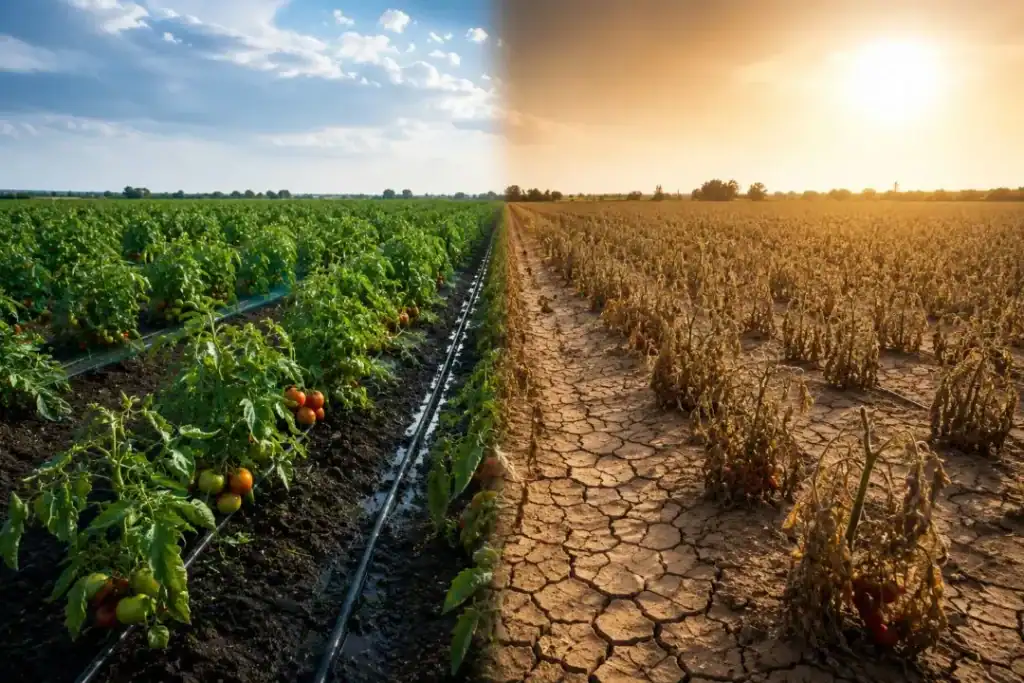
During 2026, growers across Europe, North America, South America and the Mediterranean have faced different climate-related challenges. Some regions have struggled with prolonged heatwaves, others with excessive rainfall, while water shortages continue to threaten irrigation-dependent production.
In some regions, participation in carbon markets may also provide an additional income stream while supporting climate-smart agriculture.
The Four Biggest Climate Risks
Heat Stress
Extended periods above optimal growing temperatures reduce fruit set, fruit size and overall yield.
Water Scarcity
Water availability has become one of the industry’s most valuable production inputs. Countries dependent on irrigation are facing rising costs and tighter water allocations.
Disease Pressure
Heavy rainfall and high humidity increase the risk of fungal and bacterial diseases, requiring additional crop protection and increasing production costs.
Extreme Weather
Storms, hail and irregular rainfall are making harvest planning increasingly difficult, particularly for fresh-market growers.
How Farmers Are Adapting
Leading commercial growers are responding by investing in:
- drip irrigation,
- heat-tolerant varieties,
- greenhouse production,
- precision irrigation,
- disease forecasting,
- improved soil moisture monitoring.
Many commercial growers are also adopting carbon farming practices to improve soil health, increase water retention and strengthen resilience against climate-related risks.
These investments not only reduce production risk but also improve long-term competitiveness.
Expert Insight
Climate resilience is rapidly becoming a business strategy rather than simply an environmental objective. Farms capable of maintaining consistent production under difficult weather conditions are likely to become preferred suppliers for processors and retailers.
Key Takeaway: The greatest challenge facing tomato growers in 2026 is not weak demand but increasing climate uncertainty.
Global Tomato Trade Trends in 2026
Although tomatoes are grown worldwide, international trade remains concentrated among a relatively small number of exporting countries.
China continues to dominate global tomato paste exports, while Italy maintains its premium position in canned tomato products. Turkey remains an important regional supplier, and the United States continues to influence the processing market through California’s production.
Three trade trends stand out in 2026:
- Exporters are placing greater emphasis on reliable supply rather than maximum volume.
- Premium processed products continue to outperform lower-value commodity segments.
- Weather disruptions are increasing regional trade opportunities as buyers diversify sourcing strategies.
Expert Insight
Global tomato trade is becoming more diversified. Buyers increasingly value supply reliability, product quality and long-term partnerships over the lowest available price.
Key Takeaway: International tomato trade remains strong, but climate risks and shifting sourcing strategies are reshaping how processors and importers select suppliers.
Global Tomato Market Forecast for 2027
Based on the Global Tomato Market Outlook 2026, the global tomato market is expected to remain fundamentally stable, but stability should not be confused with certainty. Production is unlikely to experience dramatic growth unless weather conditions improve across several major producing regions.
The most probable scenario for late 2026 is a market characterised by balanced supply, resilient demand and continued regional volatility. Inventories built during previous seasons should help prevent major shortages, but any prolonged heatwave, drought or disease outbreak could quickly tighten supplies and influence prices.
For 2027, the market outlook remains cautiously optimistic. Continued investment in efficient irrigation, improved tomato varieties and precision farming technologies is expected to strengthen production resilience in many regions. However, climate variability is likely to remain the industry’s biggest long-term challenge.
Expected Market Direction
| Indicator | Late 2026 Outlook | 2027 Outlook |
|---|---|---|
| Global Production | Stable to slightly lower | Moderate recovery possible |
| Fresh Tomato Prices | Stable with regional fluctuations | Stable if weather improves |
| Processing Tomato Market | Balanced | Gradual growth |
| International Trade | Stable | Moderate expansion |
| Climate Risk | High | High |
| Grower Profitability | Mixed | Improving through efficiency gains |
Key Risks to Watch
The following factors are most likely to influence the tomato market over the next 12 months:
- Extreme weather during major growing seasons.
- Water availability in irrigation-dependent regions.
- Rising labour and energy costs.
- Disease outbreaks affecting commercial production.
- Changes in international trade policies or logistics.
None of these risks guarantees major market disruption, but together they reinforce the need for careful planning and risk management.
What Growers Should Do
The tomato industry is changing. Growers who adapt early are more likely to remain competitive as production becomes increasingly influenced by climate and market uncertainty.
Practical Recommendations
- Monitor local weather forecasts throughout the growing season.
- Improve irrigation efficiency to reduce water use and production costs.
- Invest in disease monitoring and integrated crop management.
- Prioritise fruit quality and consistency rather than focusing solely on higher yields.
- Review production costs regularly and identify opportunities to improve efficiency.
- Build long-term relationships with processors and buyers to reduce marketing risk.
- Consider climate-resilient varieties where suitable for local conditions.
- Reviewing farm insurance costs and maintaining appropriate coverage can help reduce financial risk during extreme weather events.
- Growers planning long-term investments should also explore available government grants for organic farming where eligible.
For commercial growers, resilience is becoming just as valuable as productivity.
Frequently Asked Questions
Is global tomato production increasing in 2026?
Overall production remains high, but recent forecasts suggest output is slightly lower than originally expected because of weather-related challenges in several producing regions.
Why are tomato prices different between countries?
Tomato prices are influenced by local supply, weather, transportation costs, labour expenses and consumer demand. Fresh and processing tomato markets also behave differently.
Which country produces the most tomatoes?
China remains the world’s largest tomato producer, followed by India. However, the United States plays a leading role in the global processing tomato industry.
What is the biggest challenge for tomato growers in 2026?
Climate uncertainty remains the most significant challenge. Heatwaves, water shortages and disease pressure are affecting production in many major growing regions.
Will tomato prices rise in 2027?
Overall, the Global Tomato Market Outlook 2026 suggest relatively stable prices are the most likely outcome. However, future price movements will depend largely on weather conditions and production levels during the 2027 growing season.
Conclusion
The Global Tomato Market Outlook 2026 is not defined by weak demand or severe supply shortages. Instead, it is being shaped by a more complex combination of climate uncertainty, production costs and regional differences in output.
While global supply remains broadly balanced, growers can no longer rely on favourable weather or increasing production alone. Success is increasingly determined by efficient resource management, climate resilience and the ability to deliver consistent, high-quality crops.
For processors, exporters and agribusiness investors, understanding regional production trends will become increasingly important as supply patterns continue to evolve.
Overall, the Global Tomato Market Outlook 2026 suggests looking ahead, the tomato industry is expected to remain resilient, but the businesses most likely to succeed will be those that adapt quickly to changing climatic and market conditions rather than simply expanding production.
Final Outlook
| Indicator | Assessment |
|---|---|
| Overall Market | Balanced but increasingly weather-sensitive |
| Production Trend | Slightly below early-season expectations |
| Price Outlook | Generally stable with regional volatility |
| Climate Risk | High |
| Long-Term Opportunity | Investment in climate-smart production and efficient resource management |
| Overall Confidence | Cautiously optimistic |
Agro Reality Insight
The future of Global Tomato Market Outlook 2026 will not be decided by who grows the most tomatoes—it will be shaped by who can produce them most reliably in an increasingly unpredictable climate. For growers, resilience is no longer an advantage; it is becoming a requirement.