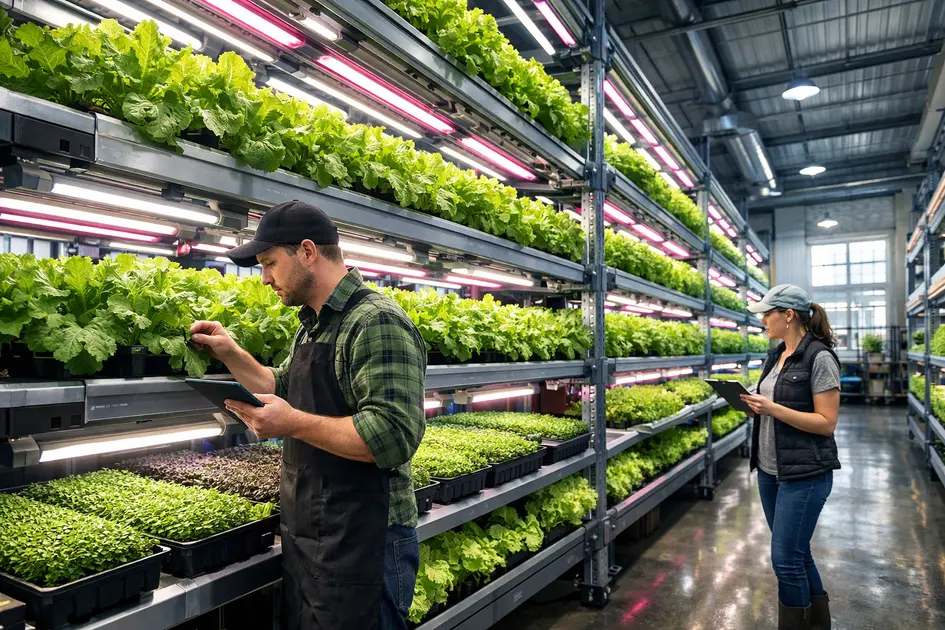
Vertical farming profit per square foot is a critical metric for urban farmers and investors evaluating modern indoor agriculture. Instead of traditional outdoor fields, vertical farms grow crops in stacked, climate-controlled systems using LED lights and hydroponics, enabling year-round production and higher yields per square foot.
One of the most important metrics used to evaluate vertical farming profit is profit per square foot. Investors and agritech entrepreneurs often use this measurement to determine whether an indoor farming operation can generate sustainable financial returns.
Unlike traditional agriculture, where productivity is measured per acre, vertical farms must maximise revenue from limited indoor space. Understanding profit per square foot helps farmers estimate potential revenue, evaluate operating costs, and determine whether a vertical farming business model is financially viable.
In this article, we will explore the real numbers behind vertical farming profitability, including revenue per square foot, operating costs, and the factors that influence profit in indoor farming systems.
For more on startup costs and investment planning, see our detailed guide on Vertical Farming Startup Cost.
What Does Profit per Square Foot Mean in Vertical Farming?
Profit per square foot refers to the amount of money a vertical farm generates from each square foot of growing space after accounting for operating expenses.
Because vertical farms operate indoors, space efficiency becomes a critical factor in business success. Farmers often stack multiple growing layers, which significantly increases production capacity compared with traditional farming.
For example, a vertical farm using five stacked layers can produce several times more crops per square foot than a conventional greenhouse.
This efficiency allows indoor farms to grow high-value crops close to urban markets, reducing transportation costs and improving product freshness.
According to research from the Food and Agriculture Organization, controlled-environment agriculture systems such as vertical farms can dramatically increase productivity while using less land and water.
Average Vertical Farming Revenue per Square Foot
Revenue in vertical farming varies depending on crop selection, technology, and market demand. However, many commercial indoor farms report annual revenue between $20 and $50 per square foot.
Some highly efficient operations producing premium crops such as microgreens or specialty herbs can generate even higher returns.
Recent market reports indicate that the global vertical farming market is projected to exceed USD 11 billion in 2026, driven by high demand for fresh produce in urban areas. North America is expected to maintain the largest market share, offering higher revenue potential per square foot due to premium pricing and dense urban populations (QuickMarketPitch, 2026). This aligns with observed revenue ranges of $20–$50 per square foot, and premium crops such as microgreens and herbs can generate even higher returns.
Typical revenue estimates include:
| Farm Type | Estimated Revenue per Sq Ft |
|---|---|
| Leafy greens farms | $20 – $40 |
| Herb farms | $30 – $60 |
| Microgreens farms | $40 – $100+ |
High-value crops are often the key to improving vertical farming profit because they can be harvested quickly and sold at premium prices in local markets.
A report by the World Economic Forum highlights that vertical farming systems can significantly increase food production efficiency in urban areas while reducing land use.
Example: Profit Calculation for a 1000 Sq Ft Vertical Farm
To understand how profit per square foot works in practice, consider a simplified example.
Annual revenue
A small indoor farm producing herbs and leafy greens might generate:
- Revenue: $40,000 per year
Operating costs
Typical operating expenses may include:
- Electricity and lighting
- Labour
- Nutrients and seeds
- Facility rent
Estimated annual operating costs:
- $30,000 per year
Estimated profit
- Net profit: $10,000 per year
This means the farm produces approximately $10 profit per square foot annually in this simplified scenario.
Actual results vary widely depending on technology efficiency, crop selection, and local market prices.
In some standard scenarios, a leafy greens farm of 5,000 sq ft can yield profits and transition to ROI in ~5–6 years with energy optimization.
Factors That Affect Vertical Farming Profit
Several factors determine whether a vertical farming operation becomes profitable.
Crop selection
High-value crops typically generate higher revenue per square foot. Microgreens, herbs, and specialty greens often produce faster growth cycles and premium prices.
Energy consumption
Electricity is one of the largest operating expenses in indoor agriculture. LED lighting and climate control systems consume significant energy, especially in large facilities.
Automation technology
Advanced automation systems can reduce labour costs and improve production efficiency. However, automation also increases startup investment.
Market access
Vertical farms located near urban markets can sell fresh produce quickly and reduce transportation costs.
Because of these factors, profitability can vary significantly between different vertical farming businesses.
Most Profitable Crops for Vertical Farms
Choosing the right crops is one of the most important decisions in indoor agriculture.
Common profitable crops include:
- Microgreens
- Basil
- Lettuce
- Arugula
- Specialty herbs
Microgreens are especially attractive for indoor farms because they have very short growth cycles and can be harvested in less than three weeks.
These crops are widely used in restaurants and premium grocery markets, which increases their commercial value.
How Vertical Farming Improves Land Efficiency
One of the biggest advantages of vertical farming is land efficiency. Traditional agriculture requires large areas of land to produce crops, while indoor farms can grow multiple layers in the same footprint.
For example, a vertical farm with ten stacked growing layers could theoretically produce ten times the output of a traditional field of the same size.
This efficiency makes vertical farming particularly attractive in densely populated cities where farmland is limited.
More information about vertical farming economics can be found in our detailed guide on
vertical farming startup cost published on AgroReality.com.
Is Vertical Farming Actually Profitable?
The profitability of vertical farming remains a topic of debate within the agriculture industry.
Many successful indoor farms operate profitable businesses by focusing on premium crops and local markets. However, some large-scale vertical farming startups have struggled due to high energy costs and expensive infrastructure.
Experts generally agree that profitability depends on several key factors:
- efficient energy use
- smart crop selection
- strong local demand
- effective farm management
When these factors are managed well, vertical farming can become a sustainable and profitable agricultural model.
Future of Vertical Farming Profitability
The future of vertical farming looks promising as technology continues to improve.
Advancements in LED lighting, automation, and artificial intelligence are helping reduce energy consumption and improve crop yields. As these technologies become more affordable, the cost of indoor farming is expected to decrease.
Many cities around the world are also investing in urban agriculture initiatives to improve food security and reduce transportation emissions.
Because of these trends, vertical farming profit potential is likely to increase over the next decade.
Conclusion
Vertical farming is transforming modern agriculture by enabling farmers to grow fresh produce efficiently in indoor environments.
While profit per square foot varies depending on crop choice and operating efficiency, many indoor farms can generate $20–$50 in annual revenue per square foot, with profit margins between 10% and 30% in well-managed operations.
For investors and entrepreneurs interested in sustainable food production, understanding vertical farming profit metrics is essential before starting an indoor farming business.
As technology improves and urban food demand increases, vertical farming may become an increasingly important part of the global food system.