
Carbon Is Becoming a Farm Output
In the USA, the UK, and the EU, progressive farmers are no longer treating carbon as an abstract climate issue, but as a quantified, contract-based revenue stream linked to carbon credits.
Across the USA, the UK, and the EU, carbon markets are quietly reshaping farm economics.
Not through ideology, but through contracts, verification protocols, and cash flow.
Large agribusinesses, food brands, and tech companies have committed to net-zero targets.
They need verified carbon reductions — and farmland is one of the few scalable solutions.
This is why soil carbon systems has moved from pilot projects to commercial reality.
This article focuses on:
- How carbon farming actually generates carbon credits
- Which practices qualify under real programmes
- How much farmers are earning — and where the risks lie
- Whether carbon farming is financially rational for progressive Western farmers
No hype. Just systems, numbers, and trade-offs.
What Carbon Farming Really Means in Practice
carbon-based farming models is not a single practice.
It is a contractual system where land management changes are translated into verified carbon outcomes.
In Western markets, carbon farming usually means:
- A baseline soil carbon assessment
- Adoption of approved practices beyond “business as usual”
- Ongoing monitoring over multi-year periods
- Third-party verification
- Issuance of tradable carbon credits
In simple terms, farmers are paid not for intentions, but for documented carbon performance.
This distinction matters.
Because carbon markets do not reward farmers for being “sustainable”.
They reward farmers for being measurably different from the regional norm.
How Carbon Farming Works Under Carbon Credit Programmes
Most carbon farming income comes from voluntary carbon markets, not government subsidies.
Most agricultural carbon credits in Western markets are issued under recognised frameworks such as the Verified Carbon Standard (VCS), which defines how soil carbon projects are measured, verified, and converted into tradable credits.
The typical workflow looks like this:
- Baseline establishment
Soil organic carbon is measured using field sampling and modelling tools. - Practice change
Farmers adopt or expand practices such as:- Continuous no-till
- Multi-species cover crops
- Extended rotations
- Improved grazing intensity
- Carbon modelling and monitoring
Digital MRV systems estimate annual carbon sequestration and emission reductions. - Verification
Independent auditors verify the data against recognised standards. - Credit issuance and sale
Credits are sold to corporate buyers or carbon marketplaces.
This system explains why agricultural carbon sequestration is capital-intensive, data-heavy, and contract-driven — not a side hobby.
Carbon Farming Practices That Actually Generate Credits

Not all “regenerative” practices qualify for carbon credits.
Most Western carbon programmes focus on practices with strong additionality and permanence.
The most credit-eligible practices include:
- Long-term no-till or reduced tillage
- High-biomass cover cropping, especially multi-species mixes
- Extended crop rotations, including legumes
- Improved pasture management and rotational grazing
- Agroforestry and tree integration on cropland
Practices must be:
- New or expanded
- Maintained for 5–10+ years
- Documented annually
This requirement excludes many early adopters — a controversial but important reality.
Carbon Credits for Farmers: How the Money Is Made
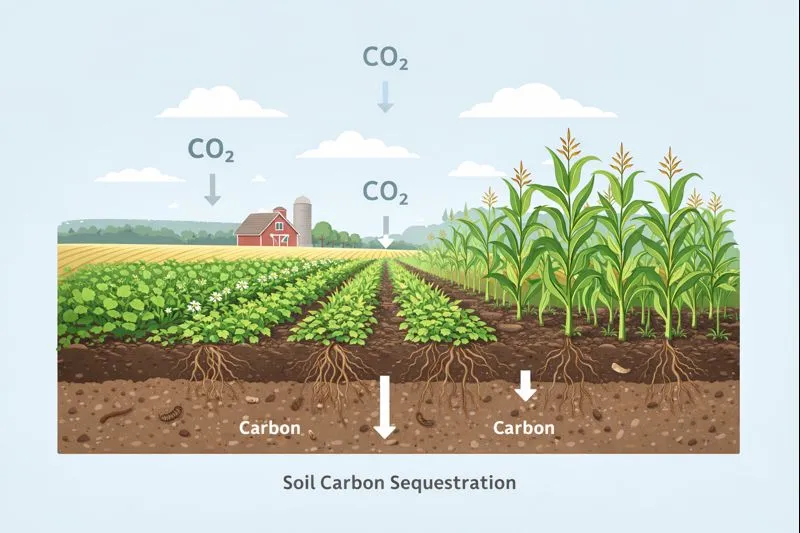
A carbon credit equals one tonne of CO₂ equivalent (tCO₂e) reduced or removed.
Farmers earn credits through:
- Soil carbon sequestration
- Reduced nitrous oxide emissions
- Improved grazing efficiency
Typical revenue ranges (Western markets):
- Arable land: 0.3–1.5 tCO₂e per hectare per year
- Grassland: 0.5–2.0 tCO₂e per hectare per year
Carbon credit prices vary widely:
- Lower-end markets: £10–£20 per credit
- Premium programmes: £30–£60+ per credit
This means carbon income is meaningful but not transformational — unless combined with input cost savings.
In addition to VCS-based projects, some Western agricultural carbon programmes also operate under the Gold Standard, which places greater emphasis on verified climate impact alongside sustainable development outcomes.
Is Carbon Farming Profitable? A Realistic Assessment
farm-level carbon programmes profitability depends on three variables:
- Carbon price stability
- Cost of practice change
- Contract flexibility
For many Western farmers, carbon income alone will not justify change.
However, when combined with:
- Lower fuel use
- Reduced fertiliser inputs
- Improved yield stability
Carbon farming can improve whole-farm margins, not just add side income.
The biggest financial winners are:
- Large acreage farms
- Digitally documented operations
- Farmers already close to regenerative systems
Carbon Farming vs Regenerative Farming: Where the Line Is Drawn
Although often confused, they are not the same.
| Aspect | Carbon Farming | Regenerative Farming |
|---|---|---|
| Primary goal | Measured carbon outcomes | System resilience |
| Verification | Mandatory | Optional |
| Contracts | Required | Rare |
| Flexibility | Limited | High |
| Risk exposure | Market-linked | Operational |
Many Western farmers now practice regenerative farming without carbon contracts — and may prefer to keep it that way.
Risks and Structural Challenges of Carbon Farming
To address ongoing quality concerns in voluntary carbon markets, independent governance bodies such as the Integrity Council for the Voluntary Carbon Market (ICVCM) have introduced Core Carbon Principles to define minimum integrity thresholds for carbon credits.
soil carbon projects is not risk-free.
Key challenges include:
- Long-term land-use commitments
- Uncertain carbon prices
- Reversal penalties
- Complex MRV systems
- Limited exit options
For tenant farmers and smallholders, these risks are often underestimated.
Carbon farming rewards stability, scale, and patience — not rapid experimentation.
Is Carbon Farming Worth It for Progressive Western Farmers?
Carbon farming makes sense when:
- Land tenure is secure
- Baseline carbon is low
- Data systems are strong
- Contracts are transparent
It makes less sense when:
- Flexibility is critical
- Land is leased short-term
- Carbon prices are speculative
For many farmers, the smartest approach is hybrid:
Use regenerative practices for resilience — and carbon markets selectively.
Conclusion: Carbon Credits Are a Tool, Not a Strategy
Agricultural carbon programmes is not the future of agriculture.
But it is becoming part of its financial architecture.
For Western farmers, the key question is not:
“Is carbon farming good or bad?”
The real question is:
Does this contract improve or restrict my long-term farm economics?
As carbon markets mature, informed farmers — not early hype — will shape who truly benefits.
FAQ
Is carbon farming profitable for farmers in the USA and Europe?
farm-level carbon systems can generate £100–£400 per hectare annually, depending on practices, verification costs, and carbon credit prices. Profitability improves when combined with reduced fuel and fertiliser use.
How many carbon credits can a farmer earn per hectare?
Most arable farms earn between 0.3 and 1.5 carbon credits per hectare per year, while managed grasslands can reach up to 2 credits, depending on baseline soil carbon and management intensity.
Do all regenerative farms qualify for carbon credits?
No. Carbon credit programmes require additionality, meaning practices must be new or expanded beyond regional norms. Early adopters are often excluded.
Are carbon farming contracts risky for tenant farmers?
Yes. Most contracts require 5–10 year commitments and penalties for reversal. Tenant farmers with short leases face higher financial and legal risks.
Can carbon farming and regenerative farming work together?
Yes. Many Western farmers adopt regenerative practices first and later enrol selected fields into carbon programmes to maintain flexibility.