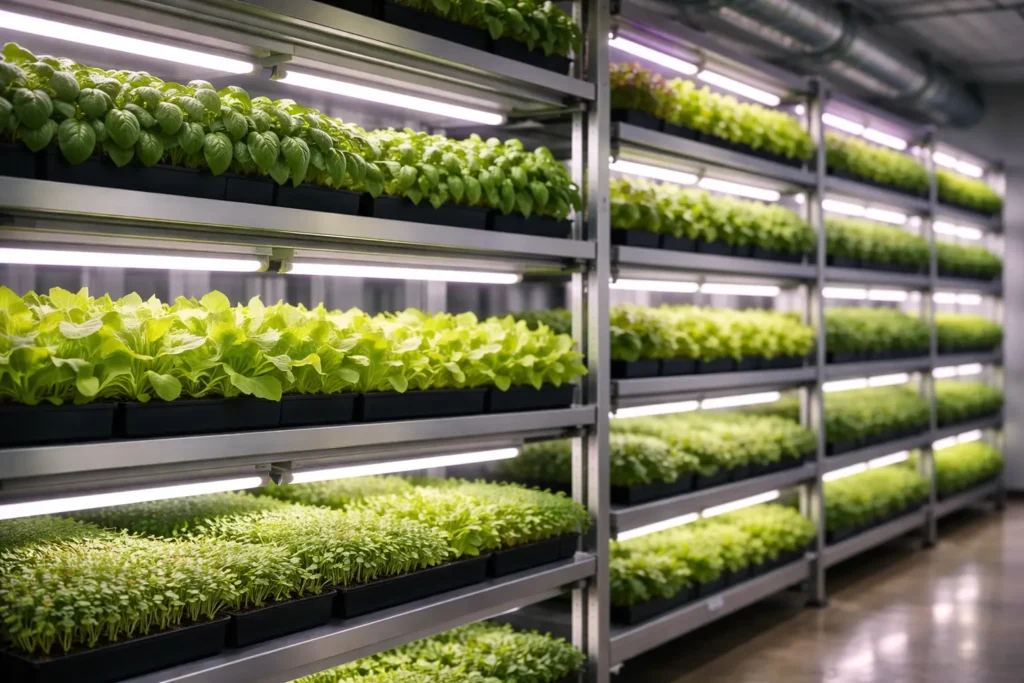
Choosing the best crops for vertical farming profit is one of the most important decisions when launching an indoor farming business. Vertical farms operate in controlled environments where electricity, lighting, and space efficiency directly affect profitability.
Unlike traditional agriculture, indoor farms cannot rely on large land areas. Instead, they must maximise profit per square foot by growing high-value crops with strong market demand and fast production cycles.
If you want to understand how indoor farms calculate profitability, read our guide on Vertical Farming Profit per Square Foot
In this article, we analyse the most profitable crops for vertical farms using practical metrics such as growth cycles, market prices, and revenue potential.
What Makes a Crop Profitable in Vertical Farming?
Not every crop is suitable for indoor farming. The most profitable vertical farming crops usually share four key characteristics.
1. Fast Growth Cycles
Crops that grow quickly allow multiple harvests each year.
Example:
| Crop | Typical Growth Cycle |
|---|---|
| Microgreens | 7–21 days |
| Lettuce | 30–40 days |
| Basil | 25–35 days |
| Kale | 40–50 days |
Short cycles mean more harvests and higher yearly productivity.
2. High Market Value
High-value crops generate better revenue per square foot.
Typical specialty market prices in the US and Europe:
| Crop | Average Market Price |
|---|---|
| Microgreens | $20–$40 per lb |
| Basil | $10–$20 per lb |
| Lettuce | $2–$3 per head |
| Mint | $8–$15 per lb |
These price levels make herbs and microgreens particularly attractive for indoor farming.
3. Space Efficiency
Vertical farms use stacked hydroponic systems, so crops must grow compactly.
Leafy greens and herbs perform well because they:
- require minimal root space
- grow well in hydroponic trays
- can be planted at high density
4. Energy Efficiency
Electricity is often the largest operating cost in vertical farming.
Crops that require lower light intensity or shorter growth cycles improve profitability.
You can learn more about operating expenses in our guide on Vertical Farming Electricity Cost.
Profit Comparison of Popular Vertical Farming Crops
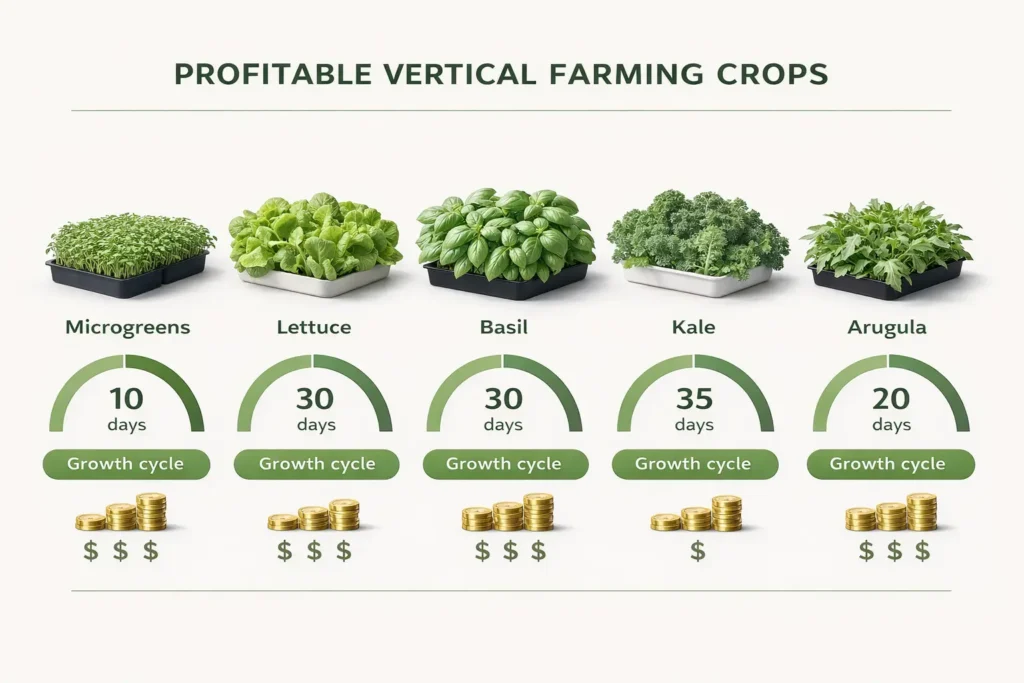
The table below compares growth speed and profit potential of common vertical farming crops.
| Crop | Growth Cycle | Yield Potential | Profit Potential |
|---|---|---|---|
| Microgreens | 7–21 days | Very High | Very High |
| Lettuce | 30–40 days | High | High |
| Basil | 25–35 days | Medium | High |
| Kale | 40–50 days | Medium | Medium |
| Arugula | 30–40 days | High | Medium-High |
| Mint | 30–45 days | Medium | Medium |
| Strawberries | 60–90 days | Medium | Medium |
This comparison explains why most commercial vertical farms focus heavily on microgreens and leafy greens.
1. Microgreens (Highest Revenue per Square Foot)
Microgreens are widely considered the most profitable crops in vertical farming.
These young vegetable greens are harvested shortly after germination and usually grow within 7–21 days.
Common varieties include:
- Radish microgreens
- Sunflower microgreens
- Pea shoots
- Broccoli microgreens
Because of their short growth cycle, microgreens allow 15–20 harvest cycles per year.
Typical wholesale prices range from $20–$40 per pound, making them extremely profitable for farms serving restaurants and specialty grocery stores.
2. Lettuce (Reliable Commercial Crop)
Lettuce is one of the most widely grown crops in commercial vertical farms.
Hydroponic lettuce grows efficiently under LED lighting and can be harvested in about 30–40 days.
Popular varieties include:
- Butterhead lettuce
- Romaine lettuce
- Green leaf lettuce
- Red leaf lettuce
Although lettuce generates lower revenue per pound than microgreens, its stable demand in supermarkets makes it a reliable commercial crop.
3. Basil (Premium Herb Crop)
Basil is one of the most profitable herbs for vertical farming.
Fresh basil is widely used in Western cuisine and restaurants frequently prefer locally grown herbs.
Benefits of growing basil indoors include:
- strong culinary demand
- premium retail price
- compatibility with hydroponic systems
- potential for repeated harvesting
These factors make basil a valuable crop for urban vertical farms.
4. Kale (Health-Focused Market Crop)
Kale has become popular in Western markets due to its reputation as a nutrient-dense superfood.
It typically grows in 40–50 days and sells well in health-focused grocery stores.
While kale grows slightly slower than lettuce, it can command higher prices in specialty markets.
5. Arugula (Fast-Growing Specialty Green)
Arugula is widely used in salads and gourmet dishes.
It grows relatively quickly and is popular among restaurants and premium grocery stores.
Advantages of arugula include:
- fast growth cycle
- strong culinary demand
- compatibility with hydroponic systems
These factors make arugula a profitable specialty crop for indoor farms.
6. Mint and Culinary Herbs
Several herbs perform well in vertical farming environments.
Examples include:
- Mint
- Cilantro
- Parsley
- Chives
- Dill
Herbs often sell at higher prices than leafy greens and can be harvested repeatedly, improving overall productivity.
7. Strawberries (Advanced Vertical Farming Crop)
Strawberries are gaining attention in large commercial vertical farms because of their high retail value.
However, growing strawberries indoors requires:
- advanced climate control
- pollination management
- precise lighting systems
For this reason, strawberries are typically grown by large automated vertical farms rather than small startups.
Crops That Do Not Work Well in Vertical Farms
Some crops are inefficient for vertical farming because they require large growing areas and produce relatively low value per square foot.
Examples include:
- Wheat
- Corn
- Rice
- Potatoes
These crops are better suited to traditional outdoor agriculture.
Vertical farms focus on crops that maximize revenue per square foot.
Crop Strategy for Beginner Vertical Farms
New indoor farms often start with crops that are easy to grow and have consistent market demand.
A common beginner strategy includes:
- Microgreens
- Lettuce
- Basil
These crops offer:
- short growth cycles
- strong demand in urban markets
- high compatibility with hydroponic systems
If you’re planning to start an indoor farm, understanding the initial investment is critical. Our complete guide on vertical farming startup cost explains equipment costs, setup expenses, and ROI in detail.
Conclusion
Selecting the best crops for vertical farming profit is essential for building a successful indoor agriculture business.
Microgreens, lettuce, and herbs remain the most profitable options because they grow quickly, require minimal space, and maintain strong demand in Western markets.
As vertical farming technology continues to evolve, additional crops such as strawberries and specialty greens may become more commercially viable. However, focusing on high-value, fast-growing crops remains the most effective strategy for maximizing profit in vertical farming.
The Agro Reality Newsletter
Get weekly insights on crops, livestock, sustainable practices, agricultural economics, and real-world farming challenges—delivered to your inbox.