If you’re wondering about small farm business profit Canada, you’re not alone. Many aspiring farmers dream of turning a modest plot into a steady income stream. However, the reality is often more complex. Costs can rise quickly, markets can shift, and profit margins can feel tight.
The good news? With the right strategy, a small farm in Canada can be both profitable and sustainable in 2026. Let’s break it down step by step.
The Reality vs Opportunity
Starting a small farm in Canada looks appealing. Fresh air, independence, and growing demand for local food all sound promising.
However, many beginners underestimate costs and overestimate early profits. That’s where most fail.
On the flip side, demand for:
- Organic produce
- Local food systems
- Sustainable agriculture
…continues to grow strongly in 2026 across Canada, the US, and the UK.
Therefore, if you approach farming like a business—not just a lifestyle—you can build a profitable operation.
Cost Breakdown of a Small Farm in Canada (2026)
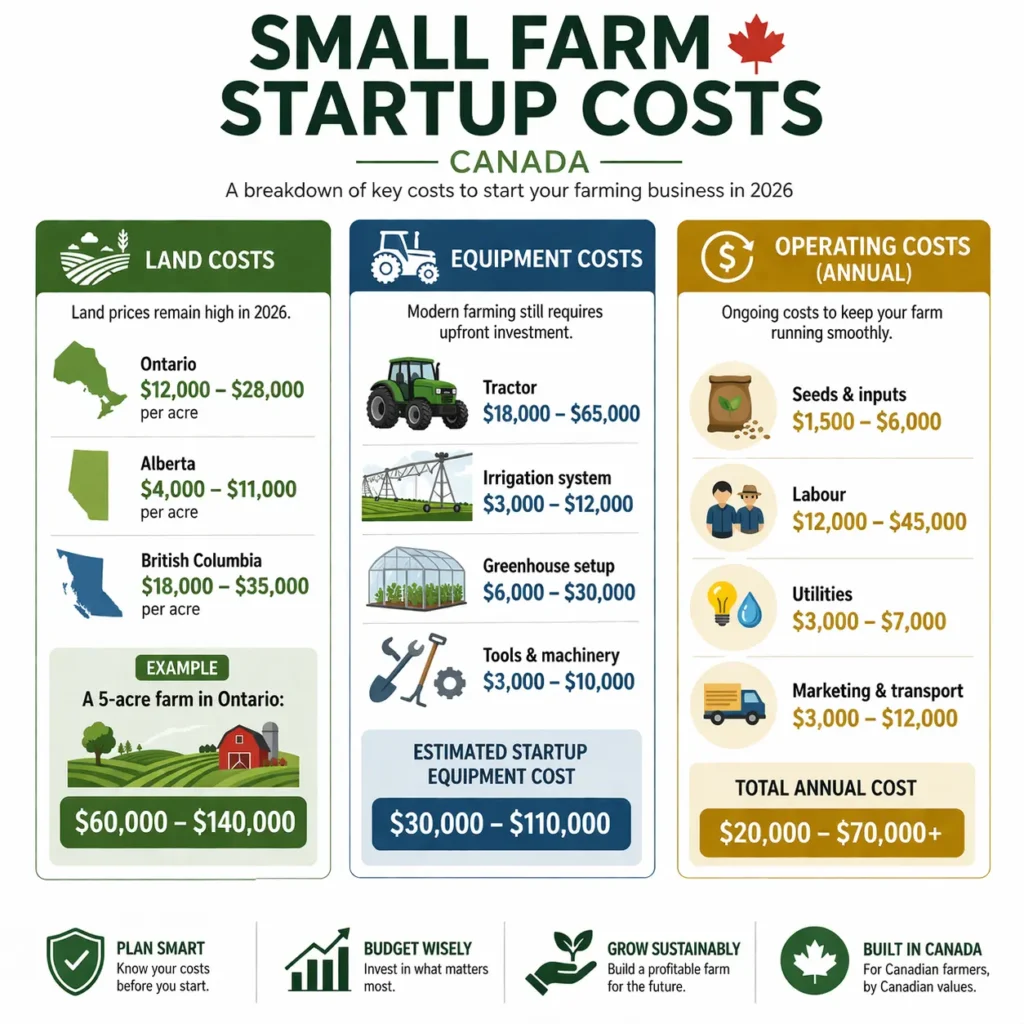
Understanding costs is critical before calculating any small farm business profit Canada.
1. Land Costs
Land prices remain high in 2026:
- Ontario: $12,000–$28,000 per acre
- Alberta: $4,000–$11,000 per acre
- British Columbia: $18,000–$35,000 per acre
Example:
A 5-acre farm in Ontario:
👉 $60,000 – $140,000
2. Equipment Costs
Modern farming still requires upfront investment:
- Tractor: $18,000 – $65,000
- Irrigation system: $3,000 – $12,000
- Greenhouse setup: $6,000 – $30,000
- Tools & machinery: $3,000 – $10,000
Estimated startup equipment cost:
👉 $30,000 – $110,000
3. Operating Costs (Annual)
- Seeds & inputs: $1,500 – $6,000
- Labour: $12,000 – $45,000
- Utilities: $3,000 – $7,000
- Marketing & transport: $3,000 – $12,000
Total annual cost:
👉 $20,000 – $70,000+
4. Total Initial Investment
For a small farm in 2026:
- Low budget: ~$60,000
- Mid-range: ~$140,000
- High-end: $220,000+
Profit Potential & ROI Analysis (2026)
Now, let’s answer the key question: Is small farm business profit Canada realistic in 2026?
Average Revenue Streams
Depending on your niche:
- Vegetables (intensive farming): $25,000 – $110,000/year
- Poultry/eggs: $15,000 – $60,000/year
- Dairy (small-scale): $40,000 – $160,000/year
- Specialty crops (berries, herbs): $30,000 – $130,000/year
Example Profit Scenario
5-acre vegetable farm (intensive):
- Revenue: $70,000/year
- Costs: $35,000/year
👉 Net profit: $35,000/year
ROI Timeline
- Year 1–2: Low or negative profit
- Year 3–4: Break-even
- Year 5+: Strong profitability
However, choosing the right niche can accelerate profits.
Step-by-Step Guide to Start a Profitable Farm
Step 1: Choose a High-Profit Niche (See the most profitable crops in Canada)
Top profitable niches in 2026:
- Microgreens
- Organic vegetables
- Free-range eggs
- Medicinal herbs
These offer high returns on small land.
If you’re considering vegetables, tomatoes remain one of the most reliable options. You can read our complete guide on Tomato Farming in Canada – How to Grow Commercially to understand the full process, costs, and profit potential
Step 2: Create a Business Plan
Include:
- Startup costs
- Revenue projections
- Marketing strategy
- Profit timeline
Step 3: Start Small (Scale Later)
Avoid heavy debt early.
- Start with 1–2 acres
- Test demand
- Expand gradually
Step 4: Sell Direct-to-Consumer

Maximise profit by selling through:
- Farmers markets
- CSA subscriptions
- Online platforms
Step 5: Optimise Costs
Reduce expenses by:
- Buying used equipment
- Using solar or efficient systems
- Automating irrigation
Tools & Equipment (With Price Ranges)
These tools directly impact your small farm business profit Canada:
| Tool | Price Range (USD) | Purpose |
|---|---|---|
| Compact Tractor | $18,000–$45,000 | Field work |
| Walk-behind Tractor | $4,000–$12,000 | Small farms |
| Drip Irrigation | $800–$6,000 | Water efficiency |
| Greenhouse | $6,000–$30,000 | Year-round farming |
| Cold Storage | $3,000–$18,000 | Reduce waste |
Market Opportunities in Canada (2026)
1. Organic Food Market
Canada’s organic market is projected to exceed $9 billion in 2026.
2. Local Food Demand
Consumers increasingly prefer:
- Local produce
- Sustainable farming
- Transparent sourcing
3. Direct-to-Consumer Growth
Online farm sales and subscriptions are expanding rapidly.
Challenges + Smart Solutions
Challenge 1: Rising Costs
Solution:
Focus on high-margin crops and reduce waste.
Challenge 2: Climate Variability
Solution:
Use greenhouses and crop diversification.
Challenge 3: Labour Issues
Solution:
Invest in automation and seasonal workers.
Challenge 4: Competition
Solution:
Build a strong brand and niche positioning.
Is It Worth It? (Financial Evaluation)
Let’s be realistic.
Farming in 2026 is competitive—but still profitable.
Quick Financial Verdict:
| Factor | Rating |
|---|---|
| Profit Potential | ⭐⭐⭐⭐☆ |
| Risk Level | ⭐⭐⭐☆☆ |
| Time to Profit | ⭐⭐⭐☆☆ |
| Scalability | ⭐⭐⭐⭐☆ |
👉 Final Answer: Yes, small farm business profit Canada is achievable in 2026 with the right strategy.
FAQ Section
1. What is the average small farm income in Canada in 2026?
Most small farms earn between $15,000 and $120,000 annually, depending on niche and scale.
2. Which farming is most profitable in Canada?
Top options include:
- Microgreens
- Organic vegetables
- Poultry
- Herbs
3. How long does it take to make a profit?
Typically 3–5 years, but niche farms can earn sooner.
4. Can you start with low investment?
Yes. Options include:
- Leasing land
- Backyard farming
- Minimal tools
5. Is farming a good business in 2026?
Yes. Demand for local, organic, and sustainable food continues to rise.
Conclusion
Building a profitable farm in Canada in 2026 is achievable—but only with a smart approach.
Focus on:
- High-margin crops
- Efficient cost management
- Direct sales channels
Start small. Stay consistent. Scale strategically.
With the right mindset, your small farm business profit Canada journey can turn into a sustainable and rewarding income.